EUDR: what does the new deforestation regulation mean for your chain?

The EU deforestation-free regulation (EUDR) is changing how companies source, track and report raw materials and products. The key is to be able to prove that your products are deforestation-free and legal, traceable to the parcel level. This requires clear processes, data quality and tight collaboration with suppliers.

What is EUDR

The EUDR is the European regulation to prevent products linked to deforestation or forest degradation from entering the EU market. The rules apply to a fixed set of raw materials and derived products, such as cattle, palm oil, soy, cocoa, coffee, natural rubber and timber. For these categories, you must collect information on origin, legality and geolocation, assess risks and – depending on your role – submit a due-diligence statement in the EU system.

For whom is the EUDR

Operator
This is the party that first introduces an EUDR product to the EU market or exports it from the EU. Operators perform full due diligence, including collecting plot coordinates, assessing and mitigating risks, and submitting the due diligence statement.

Trader (trader/distributor)
These are parties that resell EUDR products already on the EU market. Traders have minimum information and tracking obligations and – depending on company size – additional due diligence obligations.

EU factory/producer
Do you produce with EUDR raw materials and place the finished product first on the EU market? Then you are operator with full due diligence obligation.

When does the legislation go into effect

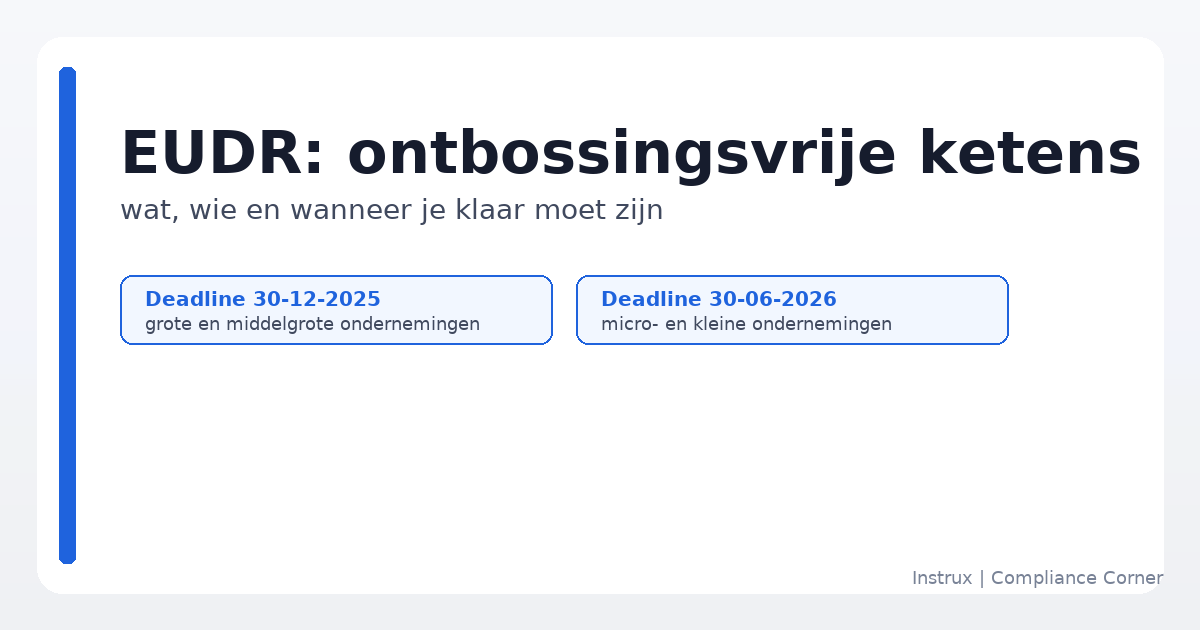
The obligations apply in phases. Large and medium-sized enterprises must comply as of Dec. 30, 2025. Micro and small enterprises are granted an extension until June 30, 2026. Please note that micro and small enterprises trading in wood and wood products do already fall under the rules as of December 30, 2025.

Medium-sized company: fewer than 250 employees and annual sales of up to €50 million or balance sheet total of up to €43 million

Microenterprise: fewer than 10 employees and annual turnover or balance sheet total of no more than €2 million

Small business: fewer than 50 employees and annual turnover or balance sheet total of no more than €10 million

What should a company actually do/have

Scope and product mapping

  • Map which products and CN codes fall within scope.
  • Identify all EUDR commodities and relevant derivatives in your portfolio.

Traceability down to the plot level

  • Collect geolocations (coordinates) of plots where raw materials were produced or harvested.
  • Link batches to plots and record chain steps (farmer → processor → trader → factory → market).

Due diligence process

  • Collect mandatory information: legality, deforestation-free, geolocation, production date/origin, supply chain partners.
  • Conduct a risk assessment by country/region/supplier.
  • Mitigate risks with additional controls, audits, satellite monitoring or vendor switching.
  • Document decisions and preserve evidence systematically.

Submission and file management

  • As an operator, submit a due diligence statement to the EU Information System prior to market entry.
  • Secure version control, reference IDs per shipment and retention periods.

Contractual assurance

  • Capture EUDR requirements in procurement terms and SLAs (delivery of coordinates, legality proofs, data standards).
  • Build in penalties and remedies for supplier non-compliance.

Organization, training and tooling

  • Assign roles and responsibilities (procurement, logistics, QA, sustainability, legal).
  • Train teams on data quality, chain mapping and risk assessment.
  • Choose IT solutions for traceability, data validation and reporting.

Specific to traders

  • Establish robust information and traceability records.
  • Keep supplier and batch information and provide it to buyers as needed.

Quick start in 6 steps

  1. Create a product list with CN codes and highlight EUDR critical items.
  2. Ask vendors for plot coordinates and legality documents.
  3. Map the chain and determine where the first placement in the EU market occurs.
  4. Assess risks by origin and plan mitigation.
  5. Test a pilot submission in the EU information system and ensure archiving.
  6. Train teams, monitor compliance and review your risk assessment annually.

Ready for EUDR with Instrux

Want to be sure at once what your organization needs and how to set it up smartly? Instrux helps you from scope check and supplier briefing to due diligence, traceability and a trial submission to the EU system. We translate the requirements into workable processes, templates and clear responsibilities, so you can go live on time and with confidence. Schedule a no-obligation intake and receive a concrete roadmap with priorities, lead time and quick wins for your supply chain.

Getting your business ready for an NVWA inspection

A visit from the Dutch Food and Consumer Product Safety Authority (NVWA) can be quite exciting for companies. However, with proper preparation, you can ensure a flawless audit. In this blog, we discuss what the NVWA does, what it checks for and how you can prepare.

Who is the NVWA and what does it do?

The NVWA is a government agency that oversees the safety of food, consumer products, animal welfare and public health. Their goal is to minimize risks to humans, animals and nature through inspections and controls. The NVWA conducts inspections of businesses in various sectors, including the food industry, retail, hospitality and health care.

What does the NVWA check for?

In product safety, the NVWA checks for, among other things:

  • Chemical composition: Are the products free of harmful substances such as heavy metals, pesticides or other banned chemicals?
  • Physical properties: Do the products meet the requirements in terms of strength, fragility and other physical properties that may pose a hazard?
  • Safety: Have appropriate risk assessments been applied?
  • Labeling and packaging: Are products correctly labeled and packaged according to regulations?

How can you be prepared?

Proper preparation for an NVWA inspection can make all the difference. Here are some steps you can take:

  1. Conduct self-inspection: Conduct regular internal audits to identify and address potential risks. In doing so, check for compliance with chemical, physical and microbiological safety requirements.
  2. Documentation in order: Ensure that all necessary documents, such as product analyses, safety sheets and registration forms, are current and available. A well-documented system helps demonstrate compliance during an inspection.
  3. Training and awareness: Train your staff on the relevant rules and procedures to ensure everyone is prepared for an inspection. Regular training ensures that employees stay abreast of the latest laws and regulations.
  4. Use external expertise: Engage experts to review your processes and advise on possible improvements. Outside consultants can help you identify weaknesses and implement best practices.

At Instrux, we offer comprehensive support to help you prepare for an NVWA inspection. Our services include process analysis, risk assessments, training and guidance during inspection. Our experts have years of experience in various industries and can help you meet all legal requirements.

Interested?

Are you interested in our support in preparing for an NVWA inspection? Contact us without obligation and find out how we can help you keep your business compliant and secure.

    EPREL – European Product Registry for Energy Labeling.

    In a world that must become ever greener, of course European legislation cannot be left behind. EPREL, the European Product Database for Energy Labeling, is one of these new green regulations that have significant impact on both manufacturers and entrepreneurs within the European Union. In this blog, let’s explore the essence of EPREL, discover for whom it is relevant, what products it covers and what legal obligations are involved.

    What is EPREL?

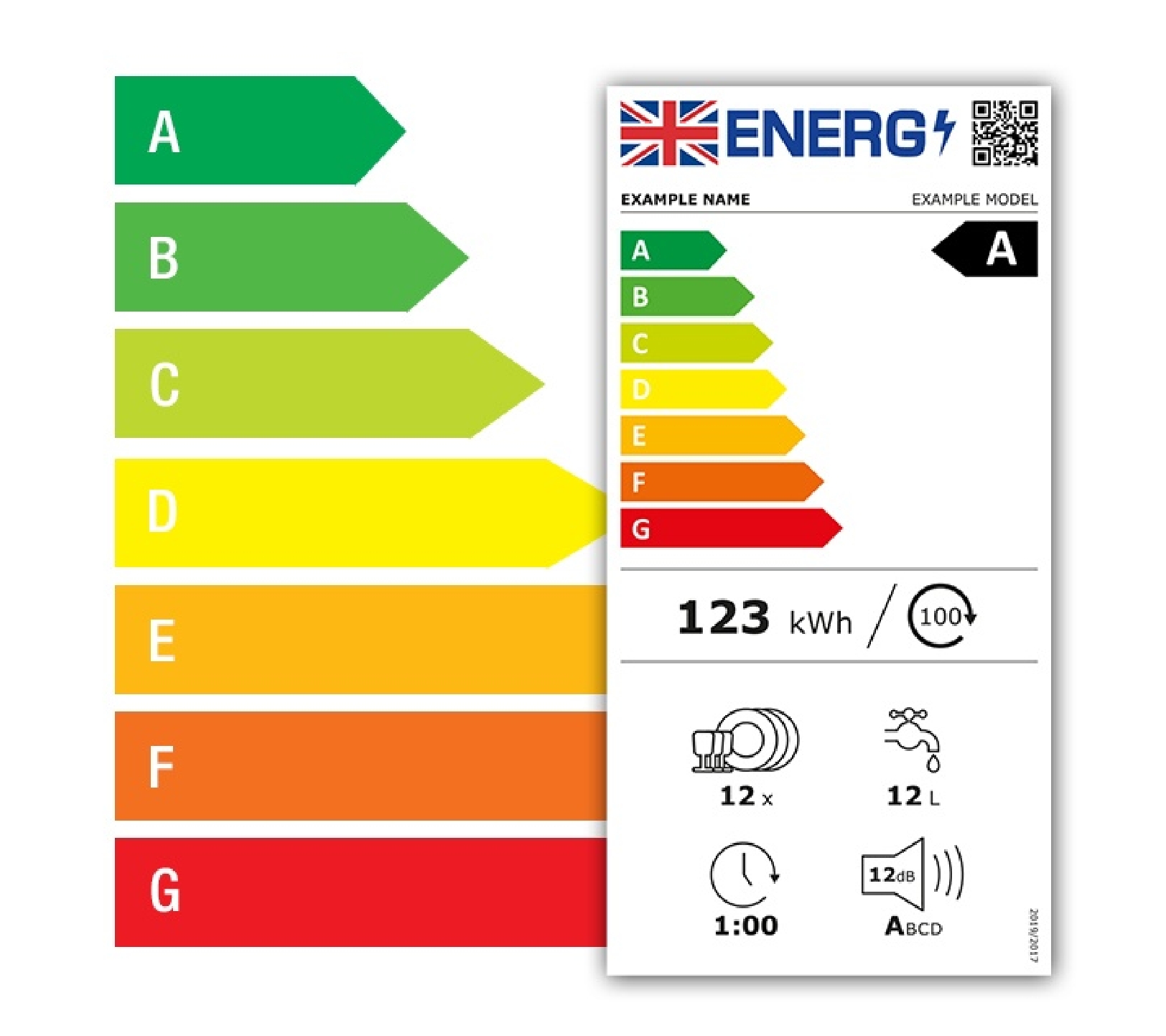
    EPREL is a central database established under the Energy Labeling Regulation. The purpose of these regulations is to provide consumers with detailed information about the energy efficiency of products. It requires manufacturers to register their products in the database and provide essential documentation, enabling consumers to make informed choices for sustainable purchases. The available information lets consumers see, among other things, how sustainable and energy-friendly a product is. In this way, producers are pushed to ensure that they develop sustainable products.

    Who is EPREL for?

    EPREL is of interest to manufacturers and entrepreneurs who market products within the European Union. Whether you are an e-commerce entrepreneur selling electronics or a manufacturer of home appliances, it is critical to be aware of and comply with EPREL requirements.

    Products covered by EPREL: Relevant for E-commerce Entrepreneurs

    For e-commerce entrepreneurs, it is helpful to know which products are specifically covered by EPREL. Consider electronic devices such as laptops, refrigerators, washing machines, and lighting systems. If you offer a wide range of products, it is important to understand which categories are covered by these regulations so that you can meet registration requirements in a timely and accurate manner.

    • Electronics: laptops, tablets, smartphones
    • Household Appliances: Refrigerators, washing machines, dishwashers.
    • Lighting: LED lamps, fixtures

    Having this label in place in a timely manner is recommended not only because it is a legal requirement, but also for marketplaces. More marketplaces such as Bol.com and Amazon are increasingly strict with their partners that they comply with EPREL rules.

    Click here for the full list of products that require labeling.

    What is a manufacturer required to do?

    From the Energy Labeling Regulation (Regulation (EU) 2017/1369), there is a whole laundry list of legal requirements that manufacturers and importers must meet. This regulation is not just a set of rules; it is a guide for manufacturers to market sustainable and energy-efficient products.

    Energy Efficiency as a Priority

    One of the core requirements is that manufacturers and importers must take the energy efficiency of their products seriously. Registering products in the EPREL database not only fulfills legal obligations, but also contributes to understanding the carbon footprint of various consumer products.

    Strict Documentation Policy

    Detailed energy efficiency documentation is more than just an administrative burden. It is an opportunity to educate consumers about the ecological impact of their purchases. From energy classes to specific features, this documentation provides consumers with the information they need to make informed choices based on sustainability criteria.

    Up-to-date Keeping Product Information

    Regularly updating the EPREL database with accurate information is not only an obligation but also a responsibility to consumers. Consumers have the right to recent data to make informed decisions that align with their enduring values. Manufacturers play a crucial role in this by ensuring that information remains current even after the initial registration of their products.

    What can Instrux do for you:

    Instrux is your reliable partner for EPREL registration. Our team of experts conducts thorough tests on your products, manages the registration process, and provides detailed documentation in accordance with the Energy Labeling Regulation. We regularly update the EPREL database with the latest product information, ensuring that your products are brought to market quickly and smoothly. You can request a label from Instrux very easily here.